
AI Is Now Regulated in India. Here’s What That Actually Means for Creators.
On 10 February 2026, something subtle but historic happened.
India officially amended the IT Rules and, for the first time, created a formal legal category for “synthetically generated information.”
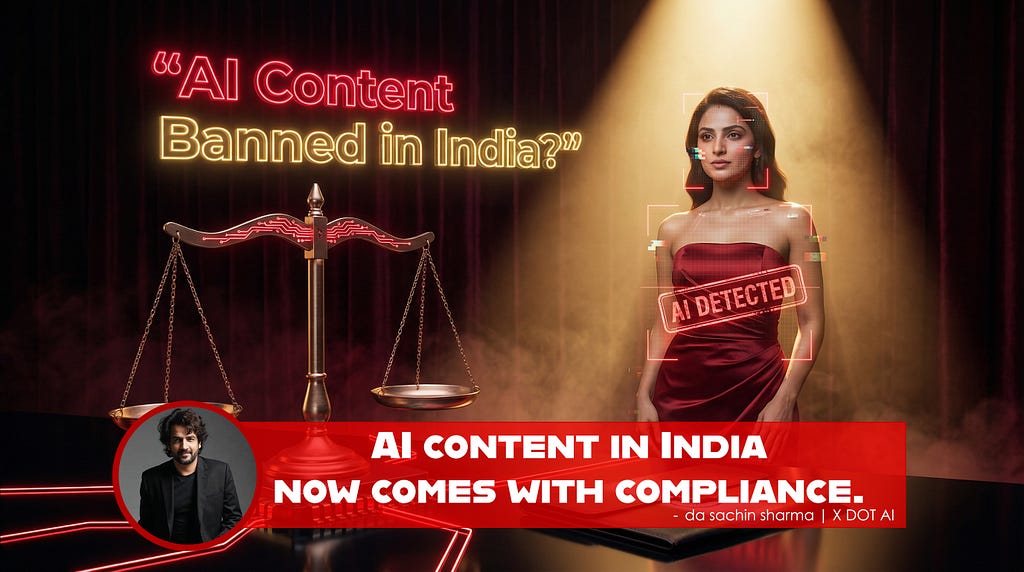
Translation?
AI-generated audio, video, and realistic visual content now has a defined place in law.
- Not banned.
- Not feared.
- But formalised.
And that changes everything.
We’ve moved from “optional disclosure” to “mandatory responsibility”
For the last few years, AI content lived in a grey zone. Some creators labelled it. Some didn’t. Platforms encouraged transparency but stopped short of strict enforcement. That phase is over. The new amendment says: If content is generated or materially altered using AI in a way that appears real , it must be declared, labelled, and where possible, embedded with technical provenance that cannot be removed later.
That’s not a suggestion. That’s compliance.
First, the good news (yes, there is good news)
The law makes an important distinction. Routine and good-faith edits are not treated as synthetic deception.
- Colour correction.
- Compression.
- Transcriptions.
- Accessibility formatting.
- Educational drafts.
These are safe , as long as they do not distort context or fabricate records. This is crucial.
It protects professional post-production work from being confused with misleading AI fabrication. In simple words: editing is not illegal. Deception is.
The real shift: Platforms are no longer neutral
Earlier, platforms were passive hosts. Now they are compliance actors.
If a platform enables AI content creation or hosting, it must:
- Require users to declare synthetic content
- Technically verify that declaration
- Add prominent labels
- Prefix audio disclosures Embed non
- removable metadata where feasible
- And here’s the important part:
That label cannot be stripped downstream. So yes, this is not just about captions. It’s about system-level traceability. Trust is now technical, not just ethical.
Speed just became a serious factor
Timelines have tightened.
Certain removal directions that earlier allowed 36 hours now require action within three hours.
Three hours. That changes operations.
If you run a platform, studio, or creator-led channel, your escalation cycle must be ready. Logs, declarations, documentation, internal review , these can no longer be afterthoughts.
AI is still creative.
But the environment around it is now procedural.
What changes for the content industry?
Let’s break this down practically.
1. Production workflows will change
Studios will adopt toolchains that preserve metadata and embed provenance by default.
Compliance-friendly tools will win.
Manual captions won’t be enough if your distribution partner demands cryptographic markers.
AI filmmaking is still possible.
But now it must be auditable.
2. Distribution will get more curated
High-risk formats , such as voice cloning of real people, political simulation, realistic reenactments , will face stricter scrutiny.
Upload friction may increase.
But ironically, that friction could increase trust.
Labelled synthetic media may carry higher legitimacy than “unmarked realism.”
3. Advertising and brand safety improve
For brands, this is positive.
Clear labelling reduces risk.
Provenance-backed inventory may begin to command a premium.
Trust will have commercial value.
4. Creators will split into two categories
We will likely see: Hobby AI usage Professional AI pipelines
Professionals will maintain: Consent documentation Prompt logs Model records Internal synthetic registers
This is the moment when creators stop being casual users of AI and start becoming structured operators.
But here’s the subtle risk
Automation plus strict deadlines can increase false positives.
Satire. Parody. Docudrama. Educational simulations.
If documentation and disclosure are weak, lawful content may get removed. So intention alone is no longer enough. Documentation becomes protection.
What you must do if you create AI content
- Treat labelling as non-negotiable.
- Maintain consent documentation when using real likeness or voice.
- Keep prompt logs and model usage notes.
- Build audit trails into your workflow.
- Avoid high-risk categories involving minors, impersonation, false documents, or explosive guidance.
AI is not banned.
But irresponsible AI is.
The bigger picture
This amendment does not shut down AI creativity.
It formalises it.
We are entering a phase where:
Disclosure is infrastructure Traceability is default Platforms are compliance partners Trust has technical architecture AI innovation is still allowed.
But now, imagination must scale with accountability.
Bottom line
India’s 2026 IT Rules amendment is not anti-AI. It is post-experiment-AI. The sandbox phase is closing. The system phase is beginning. In this environment, the winners will not be the fastest generators. They will be the most organised creators.
Because in this new cycle, trust is the real infrastructure.
Follow me da sachin sharma
If you want to understand how AI fits into responsible creative workflows, grab my book Prompt DOT AI: Art of Writing Generative AI Prompts.