
How India Is Re-Architecting the Orange Economy for the Age of AI
Union Budget 2026–27
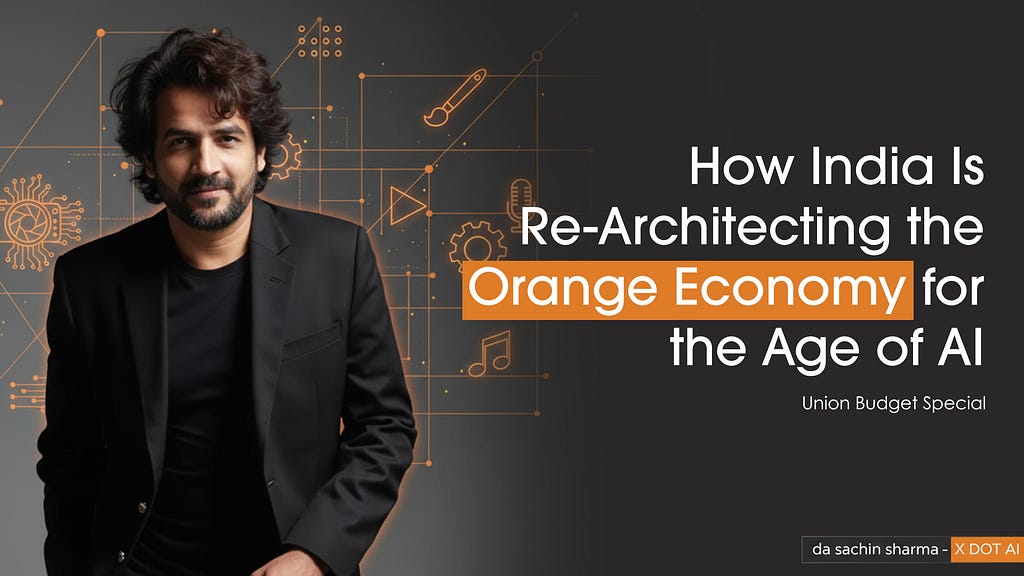
One more orange. Coincidence or something deeper?
Before we get serious, let’s start with a little fun.
Every time we hear the phrase “orange economy”, there’s a small pause in the mind.
Is it just a colour?
Is it a vibe?
Is it subconsciously trying to woo young adults and creators?
Let’s avoid politics here. No debate on where the term came from or who named it. Just the idea.
Orange sits in a curious space. It is not aggressive like red. Not passive like blue. It signals energy, warmth, curiosity, expression. It is the colour of ideas in motion.
Now look at what the orange economy represents. Content, culture, storytelling, music, design, gaming, films, creators, digital platforms. Industries where participation matters as much as consumption.
Suddenly, the colour doesn’t feel accidental.
Whether intentional or not, the orange economy sounds alive. Unfinished. Something you engage with, not something handed down to you. And in an AI-driven world, that distinction matters.
Creativity is no longer a soft output
When the Union Budget 2026–27 was presented, most discussions stayed around infrastructure, taxation, and large technology missions. But quietly, something more structural shifted.
For the first time, India no longer seems to view creativity and cultural production as soft or secondary outcomes of growth. They are being treated as industrial capacity.
This marks the formal elevation of the orange economy into India’s long-term growth strategy, with AI positioned as its primary accelerator.
Globally, the orange economy includes industries built around creativity and culture. In India, that spans animation, VFX, gaming, comics, music, digital video, advertising, and creator-led platforms. What the budget makes clear is that AI is no longer peripheral to these sectors. It is being woven directly into how creative work will be learned, produced, distributed, and monetised.
AI as a force multiplier and what it signals for creators
The budget describes AI as a “force multiplier” for governance. This is often interpreted through an administrative lens, but its implications for the orange economy are just as significant.
When governments adopt a technology at a system level, they set standards. For scale. For language access. For localisation. For interoperability.
History shows us that public digital infrastructure eventually shapes media and content ecosystems. Telecom reshaped broadcasting. Affordable data reshaped streaming. AI entering this same infrastructure layer will shape creative industries in a similar way.
Creators in the future will be influenced less by individual tools and more by the systems those tools plug into.
Creator infrastructure as national capacity
The strongest orange-economy signal in the budget comes from the push around AVGC. Animation, Visual Effects, Gaming, and Comics.
The government estimates that this sector alone will need close to two million professionals by 2030. This scale cannot be supported by traditional art schools or fragmented training programmes.
The proposal to establish 15,000 Content Creator Labs in secondary schools and 500 specialised labs in colleges is a clear shift in thinking. Creativity is being treated as a skill that must be developed early, systematically, and at scale.
These labs are not just about learning software. They introduce students to AI-assisted storytelling, video production, localisation, dubbing, motion design, and immersive workflows. These are the pipelines that define how global content is now made.
Why the Mumbai hub matters
Positioning the Indian Institute of Creative Technologies in Mumbai as the central hub is a strong signal of intent.
It suggests that the ambition is not just to build execution capacity, but to create globally competitive creative talent. In an AI-driven world, value shifts away from labour and towards intellectual property, formats, and culturally resonant narratives.
By anchoring creator education in AI-native workflows, the budget points towards a future where India is not just a content factory, but a source of original creative output.
AI, language, and cultural reach
The orange economy in India cannot scale without language access. Initiatives like Bharat-VISTAAR, while often discussed in the context of governance and agriculture, have deeper implications for creative industries.
AI systems built for multilingual, low-bandwidth, last-mile access form the backbone for Indian-language content, regional storytelling, and creator platforms.
The same language intelligence that serves farmers today will enable dubbing, translation, voice-based storytelling, and cross-regional content tomorrow. In the orange economy, this determines whether AI flattens culture or amplifies it.
Compute, cloud, and the economics of creation
The extension of tax benefits till 2047 for foreign cloud providers using Indian data centres reshapes the economics of creativity.
Modern creative production is compute-intensive. Generative video, real-time animation, volumetric capture, and immersive experiences all depend on processing power.
By anchoring compute infrastructure in India, the budget lowers cost barriers, reduces latency, and widens access. This enables not just big studios, but mid-sized creators to work with advanced AI tools. In the orange economy, compute is not abstract infrastructure. It is creative leverage.
From degrees to creative readiness
The budget also acknowledges that degrees alone no longer guarantee employability. This is especially true in creative fields.
What matters increasingly is portfolio strength, adaptability, and tool fluency. By focusing on skilling, applied learning, and real project environments, the system shortens the gap between education and production.
Creators trained with AI as part of their process are less likely to see automation as a threat. They see it as an extension of creativity. This mindset shift may turn out to be more valuable than any single funding allocation.
What the orange economy shift really means
Seen through this lens, Union Budget 2026–27 is not just about technology adoption. It is about redefining creativity as infrastructure.
AI is not positioned as a replacement for imagination, but as the system through which imagination can scale, travel across languages, and generate sustained economic value.
Execution risks remain. Curriculum quality, faculty readiness, and equitable access will decide outcomes. But the direction is clear.
For decades, India talked about exporting software and services. This budget signals a deeper ambition: exporting stories, formats, experiences, and culture, powered by AI but rooted in local identity.
If followed through with intent and discipline, this may be the moment when the orange economy moved from the margins of policy to the centre of India’s economic imagination.
Follow me on linkedin da sachin sharma
If you want to learn how AI genuinely fits into creative work, grab my book Prompt DOT AI: Art of Writing Generative AI Prompts.