
Know Your Why: Before You Ask for the Prompt
After I share an AI-made image, video, or song, the first question I hear is the same every time: “What was the prompt?”
Yesterday, a friend from Learning and Development in the insurance industry heard my new track Aham Brahmasmi (अहं ब्रह्मास्मि) and asked it again. It made me smile. That question is where most people start.
https://medium.com/media/cfcb59ab265d993884e11e14df47d7fd/hrefQuick note on the track
I wrote the song myself. I used AI to help with the composition and arrangement. The vocals are AI. That mix is the point of this story.
The real work happens before the prompt
The prompt is not the hero. Your mind is.
A prompt only gives shape to a clear intention. If the intention is fuzzy, the prompt becomes a guess. Sometimes the guess surprises you and you feel you know AI. Often it misses, and you lose patience and trust.
Start with the Golden Circle
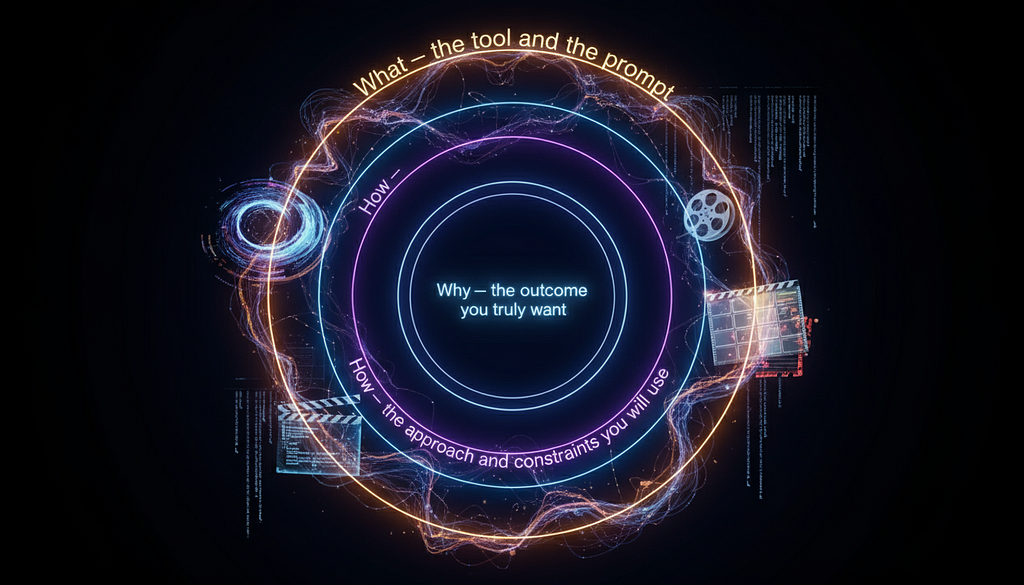
- Why , the outcome you truly want
- How , the approach and constraints you will use
- What , the tool and the prompt
Most people jump to What and get overwhelmed. AI moves fast. You do not need to learn everything. You need to know why you want AI in your craft. Once your Why is clear, the How and What become simple choices.
A short story from the studio
When I was shaping Aham Brahmasmi, I wrote the song myself. I did not begin by asking a model to write it for me.
I began with Why. I wanted a piece that felt like stillness meeting power.
Then came How. Tone, tempo, textures, energy curves.
The What came last. The tools, the specific prompts, the iterations.
Without that order, I would have produced a few surprising experiments and learnt very little.
Toolbox: Try this today
1) Five-minute Why drill
Answer in one line each:
- Who is this for
- What change should they feel after it
- Why does this matter to me right now
2) Niche finder
Circle one lane to improve first:
- Visuals for campaigns
- Short-form video edits
- Music beds and sonic identity
- Research and copy
- Presentation and pitch design
3) Outcome map
Write one focused line:
I will use AI to achieve [specific result] for [specific audience] by [date].
4) Prompt skeleton
Create [artifact] for [audience] that makes them feel [emotion].
Style [references or genre].
Constraints [length, format, tempo or shot list].
Must include [key elements or brand cues].
Avoid [what you do not want].
5) Practise, then refine
Ship a small piece. Review it against your Why. Adjust the prompt, not the purpose.
If you are in L&D for insurance
Make AI useful this week:
- Micro-scenarios. Generate three short claims or compliance cases and turn them into role-play scripts. Vary complexity and risk.
- Knowledge checks. Build a small bank of 6 to 8 questions for product features, ethics, and KYC rules. Mix MCQs with short, real-world responses.
- Policy explainers. Use a co-trainer prompt that rewrites updates into two-minute notes with one action item for frontline teams.
Signal to remember
A prompt is just a clear brief in plain English. No brief, no magic.
Wrap
If you know your Why, AI becomes a partner. If you do not, it becomes a slot machine.
Your turn
What is your Why for learning AI this month
If you are in L&D, name one learning outcome you want to improve.
CTA
Follow me @ da sachin sharma
If you want sharper prompting, grab my book Prompt DOT AI: Art of Writing Generative AI Prompts.
If you want help finding your niche and mapping AI to your role, get in touch and let us explore it together.